Draft. No visitor's card is quoted until consent is confirmed. Damilola to add what people actually wrote, with permission.
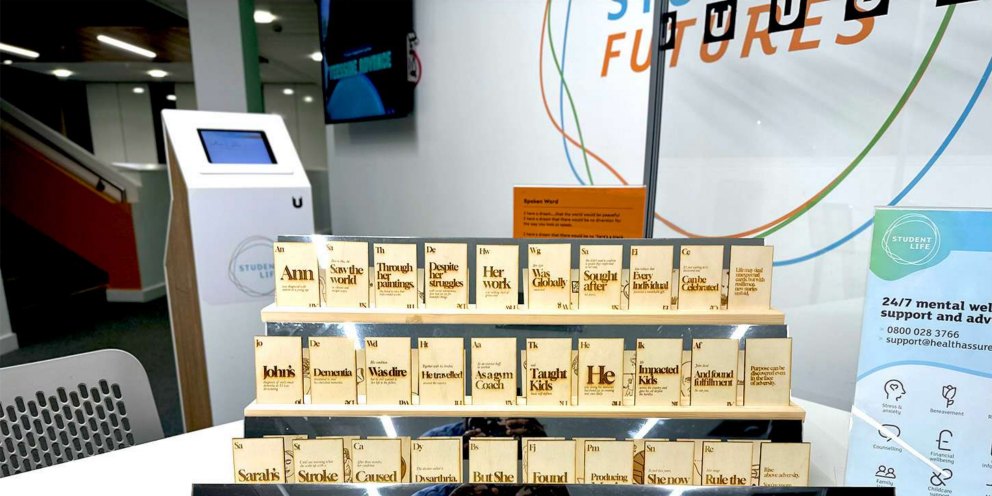
At the Deck of Triumphs installation, visitors wrote their own triumphs. This is what they chose to share.
Plain-language summary
I made a stand of wooden cards. Each card told a story about something a disabled person was proud of. Next to them were blank cards. People walking past could write their own proud moment and add it to the stand. This post is about what happened when they did.
The most important part of Deck of Triumphs was not a card I made. It was the row of blank ones.
A stand in a busy building
The installation stood in the Student Futures space of Teesside University's Student Life building. It is a busy place, used every day by students with and without disabilities. That mattered. I did not want the work in a quiet gallery that only the already-interested would visit.
The stand had three tiers of laser-etched wooden cards. Each one carried the start of a triumph story, drawn from one-to-one conversations with disabled people. In front of them sat a row of blank cards, a set of written instructions and a wooden dice.
Why leave space for strangers
A finished deck says: here are some stories, please admire them. A deck with blank cards says: this is not finished, and you are part of it.
I wanted the second message. The problem I was responding to is that the successes of disabled people are so often hidden, or told only as stories of struggle. A closed exhibition would have repeated that pattern, with me deciding whose triumphs counted.
The dice added chance. Roll it, and it nudges you towards a kind of story to tell. It lowered the pressure of the empty card.
What people chose to share
Add a summary of what visitors wrote, once consent is confirmed. For example: how many cards were added, the kinds of triumphs people chose, and one or two cards quoted with the writer's permission.
Event dates and visitor numbers to supply.
What surprised me
Damilola to add: what you did not expect. For example, who stopped, how long they stayed, or what they talked about while writing.
What I would change
Looking back, I would plan from the start how the stories travel beyond the room: who else gets to read them, and how the people who wrote them stay part of the project. I would also set up a clearer way to keep and organise the cards, so every contribution is easy to trace back to its consent.
The deck is still open. That was always the point.
Replies 1
-
Love this rationale